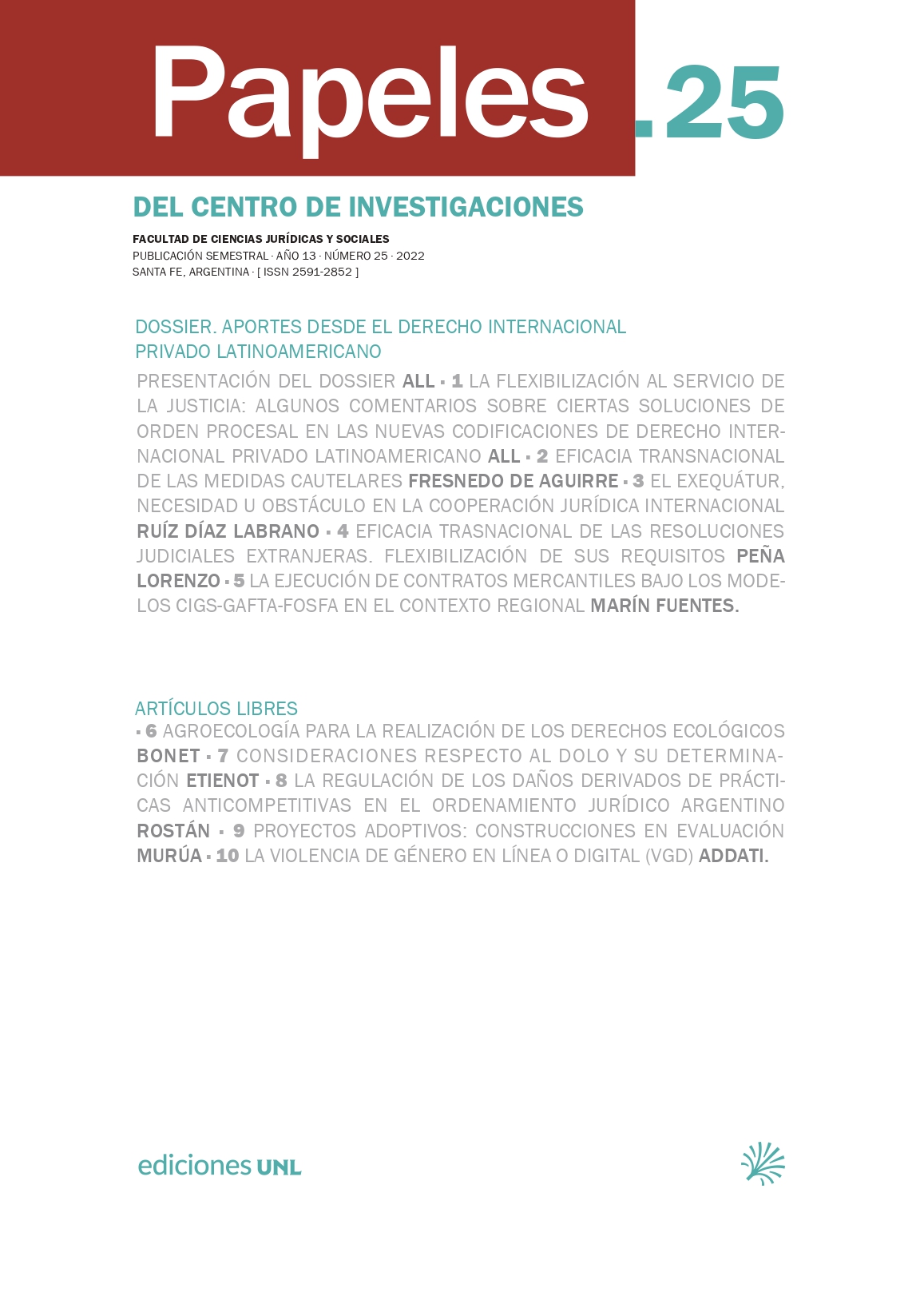
The execution of commercial contracts under the CIGS-GAFTA-FOSFA models in the regional context
DOI:
https://doi.org/10.14409/pc.v14i25.12281Keywords:
Conflicts of laws, performance, public policy, international contracts, Private International LawAbstract
The goal of this academic exercise is to verify in a somewhat tangential way how the performance of some contracts is carried out in the Latin American regional legal context; all this related to the three international main regulations in the field such as: the Vienna Convention of 1980 on the international sale of goods, the regulation of the Grain and Trade Feed Association, and that of the Federation of Oils, Seeds, and Fats Associations. In this case, we will seek to identify the most relevant aspects offered by such regulations in terms of the way in which a contract concluded under them must be executed in any of the regional legal systems. In this sense, we will show some aspects that, in our opinion, make this class of norms a novel and pragmatic legal specialty.
References
ALBORNOZ, M.M. (2009). “El derecho aplicable a los contratos internacionales en los Estados del MERCOSUR”, Boletín Mexicano de Derecho Comparado, vol. 42, (nº 125).
ALBREKTSEN, A. T. (s/f). CISG and party autonomy. Can the parties to a contract for the sale of goods implicitly exclude the application of the United Nations Convention on Contracts for the International Sale of Goods?
AYOĞLU, T. (s/f). Some Reflections on the Sources of Lex Mercatoria. Galatasaray University Law Faculty- Department of Commercial Law, https://www.trans-lex.org/bibliopdfs/tolga_ayoglu.pdf
BADDACK, F. (s/f). Lex Mercatoria: Scope and Application of the Law Merchant in Arbitration, file:///D:/Art%C3%ADculo%203/GAFTA/Art%C3%ADculos/Baddack_LLM_2005%20TESIS.pdf
BRIDGE, M.G. (2021). “The CISG and Commodity Sales: A Relationship to be Revisited?”, Singapore Journal of Legal Studies.
COVO, J. (2021). “The ‘Date of default’ Concept of the FOSFA and GAFTA Agribusiness Standard Form Contracts as Basis for Examining the Consequences of a Repudiatory Breach”, ASA Bulletin, vol. 39, (nº 1).
CHAPMAN, B. (1986), “FOSFA International Arbitration”, Arbitration International, vol. 2, (nº 4).
DE MALYNES, G. (2014). “Consueduto vel lex mercatoria, or the ancient law merchant”. En: The Lawbook Exchange, Ltd., t. I.
KOZOLCHYK, B. (2016). “The modernization and harmonization of the commercial law in the twenty-first century: the need for a new research and drafting methodology”, Arizona Journal of International & Comparative Law, vol. 33, (nº 1).
OXERA. The value of English Law, https://legaluk.org/wp-content/uploads/2021/09/The-value-of-English-law-to-the-UK-economy.pdf
POLOVETS, I., SMITH, M. y BRADLEY T. (2013). “GAFTA arbitration as the most appropriate forum for disputes resolution in grain trade”, Arizona Journal of International & Comparative Law, vol. 30, (nº 3).
SPAGNOLO, L. (2010). “Green Eggs and Ham: The CISG, Path Dependence, and the Behavioural Economics of Lawyers’ Choices of Law in International Sales Contracts”, Journal of Private International Law, vol. 6.
STANIVUKOVIĆ, M. (s/f). Choice of Court Convention (HCCC) and arbitration, phttps://www.prf.unze.ba/Docs/Anali/Analibr18god9/3.pdf
TWEEDDALE, A. y TWEEDDALE K. (2011). “Scott v Avery Clauses: O’er Judges’ Fingers, Who Straight Dream on Fees”, Arbitration, (nº 77).
Downloads
Published
Issue
Section
License
Copyright (c) 2022 José Luis Marín Fuentes

This work is licensed under a Creative Commons Attribution-NonCommercial-ShareAlike 4.0 International License.