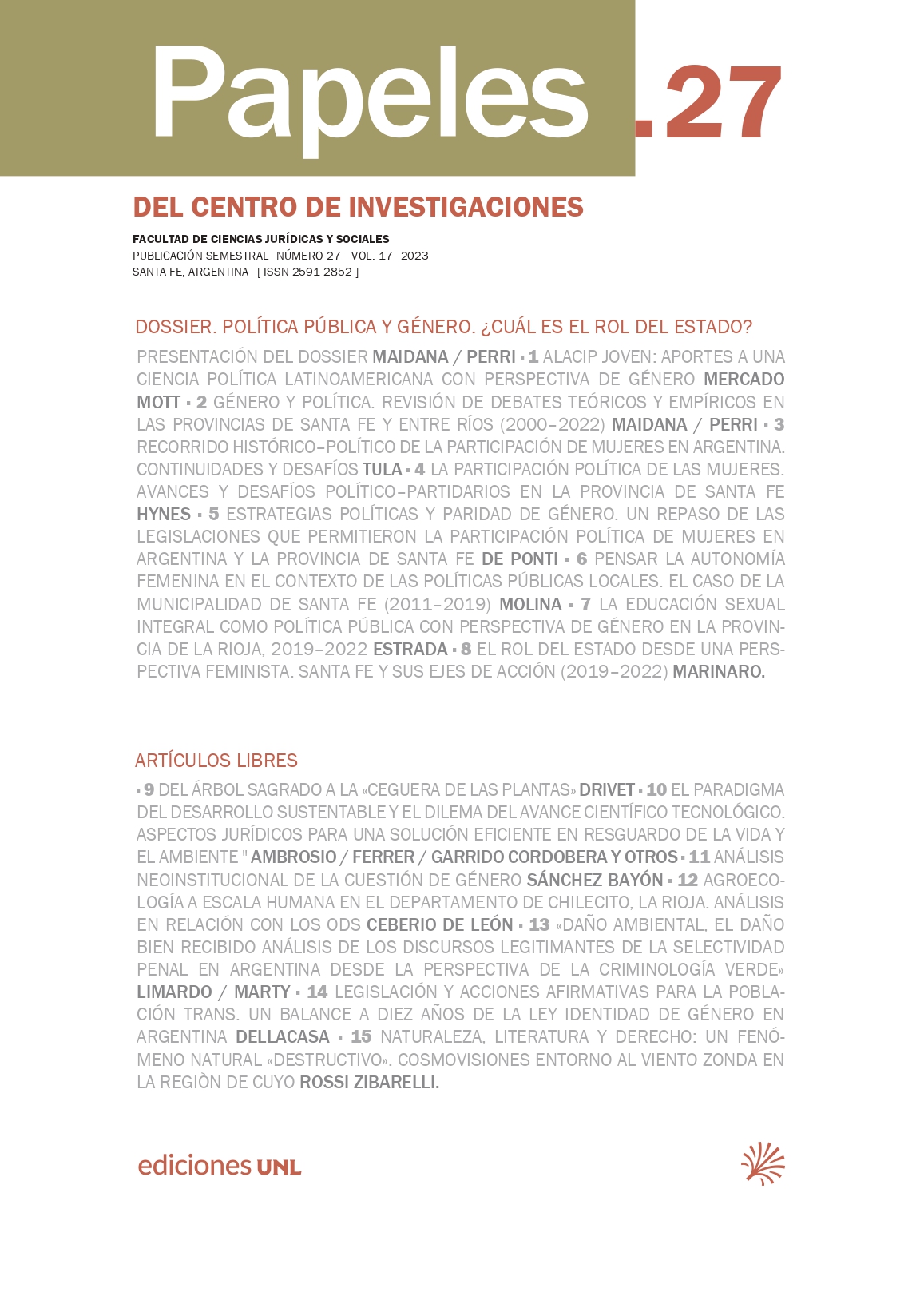
Legislation and affirmative actions for the transgender population. A ten year balance of the gender identity law in Argentina
DOI:
https://doi.org/10.14409/pc.2023.27.e0045Keywords:
Human Rights, Affirmative Actions, Gender Identity Law, Transgender Population.Abstract
This paper describes a series of regulations and policies deployed by the Argentine state during the period 2012-2022 in order to guarantee the rights of transvestites, transgender and non-binary people.
Firstly we introduce the perspective of human rights, considering that it is the most appropriate framework for the analysis of the subject, then we analyze some theoretical concepts that we resort to for the analysis, such as social recognition, equality and affirmative actions.
In second place we describe in detail the Gender Identity Law, the presidential decree that recognizes non-binary identity and the Law for the Promotion of Access to Formal Employment for Transvestites, Transsexuals and Transgender People "Diana Sacayán-Lohana Berkins", as well as the background in which its implementation took place in Argentina.
Finally, we carried out an analysis of the impact that some of the main detailed measures had on the recognition of trans people and on the improvement of their living conditions. To do this, we take as input research developed by public agencies and civil society organizations that allow us to account for the scope of the policies.
References
Alegre, V.; Bocchio, D. y Mangini, M (2017). Guía de acciones para una inclusión sociolaboral de travestis, transexual y transgéneros: Recomendaciones basadas en las acciones implementadas en ocho localidades de la Argentina. Buenos Aires: Ministerio de Trabajo, Empleo y Seguridad Social y Programa Naciones Unidas para el Desarrollo. http://municipalidadsalta.gob.ar/wp-content/uploads/2020/05/13-Guia-PNUD-Argentina-sobre-inclusion-sociolaboral-trans.pdf
Bacchi, C. (2004). Policy and discourse: Challenging the construction of affirmative action as preferential treatment, Journal of European Public Policy Vol. 11 (1), 128-146.
Brosio M., Guitart V. (2016, Octubre) “Consideraciones acerca de las estadísticas con perspectiva de género”. Ponencia presentada en las Jornadas de la Epistemología de la Economía, Buenos Aires, Argentina.
Corrales, J. (2015). LGBT rights and representation in Latin America and the Caribbean: The influence of structure, movements, institutions, and culture. The LGBT Representation and Rights Institute, Chapel Hill: University of North Carolina.
Dellacasa, M. A. (2022). Estado y procesos de vulnerabilización: análisis de las políticas de reconocimiento de personas trans, Dereito e Praxis, Vol. 13, (1), 222-250. https://www.scielo.br/j/rdp/a/hNXf7kqrKWvYjnwq3gZYFpv/?format=pdf&lang=es
(2023). Estrategias para favorecer el acceso a la atención de la salud de la población travesti y trans en Argentina. Una década de los consultorios amigables para la diversidad 2010-2020, Revista Sudamérica N° 18, 232-252. https://fh.mdp.edu.ar/revistas/index.php/sudamerica/article/view/6495/7321
Gainza, P. (2012). Políticas Públicas con perspectiva de Derechos Humanos: principales desafíos, presentación en Cuarto Congreso Uruguayo de Ciencia Política, Facultad de Ciencias Sociales, Universidad de la República, Montevideo, Uruguay.
Fraser, N. y Honneth, A. (2006). ¿Redistribución o reconocimiento?, Madrid, España: Ediciones Morata, S.L.
Fraser, N. (2016). ¿De la redistribución al reconocimiento? Dilemas de la justicia en la era ‘postsocialista. En Butler, J. y Fraser, N. ¿Redistribución o reconocimiento? Madrid: Traficantes de sueños, pp. 23-65.
Honnet, A. (1997). La lucha por el reconocimiento: por una gramática moral de los conflictos sociales. Barcelona: Crítica.
Instituto Nacional de Estadísticas y Censos (2019). Nuevas realidades, nuevas demandas: desafíos para la medición de la identidad de género en el Censo de Población. Documentos de Trabajo N° 25, Ciudad Autónoma de Buenos Aires: INDEC. https://www.indec.gob.ar/ftp/cuadros/publicaciones/identidad_genero_censo_2020.pdf
Jasanoff, S. (1996). Beyond epistemology: relativism and engagement in the politics of science. Social Studies of Science, Vol. 26 (2), pp. 393-418.
Jelin, E. (1996). La construcción de la ciudadanía: entre la solidaridad y la responsabilidad. En Jelin, E y Hershberg, E. (Eds.). Construir la democracia: derechos humanos, ciudadanía y sociedad en América Latina. Caracas: Nueva Sociedad.
Lukomnik, Julia (2013). La identidad de género en las políticas sociales. Informe de monitoreo de las políticas de inclusión para población trans, Informe Final. Dirección Nacional de Políticas Sociales, UNFPA, diciembre, Montevideo, Uruguay. Disponible en:
http://issuu.com/dnpsmides/docs/14.02_-_la_identidad_de_g__nero_en_
Miniterio de las mujeres, Políticas de género y Diversidad Sexual y Ministerio de Salud de la Provincia de Buenos Aires (2023). Cisexismo Información Epidemiológica y Salud. Aportes para el debate sobre los usos de la variable “identidad de género” en los registros de salud. https://www.ms.gba.gov.ar/sitios/generoydiversidad/files/2023/03/Cisexismo-informaci%C3%B3n-epidemiol%C3%B3gica-y-salud.pdf
Mol, A. (2008). The logic of care: Health and the Problems of Patient Choice. London: Roudledge.
Segato, R. (2006). Racismo, discriminación y acciones afirmativas: herramientas conceptuales, Serie Antropológica N° 404, pp. 108-120.
Taylor, C. (2009). El multiculturalismo y “la política del reconocimiento”. Buenos Aires: Fondo de Cultura Económica.
Young, I. (1990). La justicia y la política de la diferencia. Madrid: Cátedra.
Downloads
Published
Issue
Section
License
Copyright (c) 2023 María Alejandra Dellacasa

This work is licensed under a Creative Commons Attribution-NonCommercial-ShareAlike 4.0 International License.