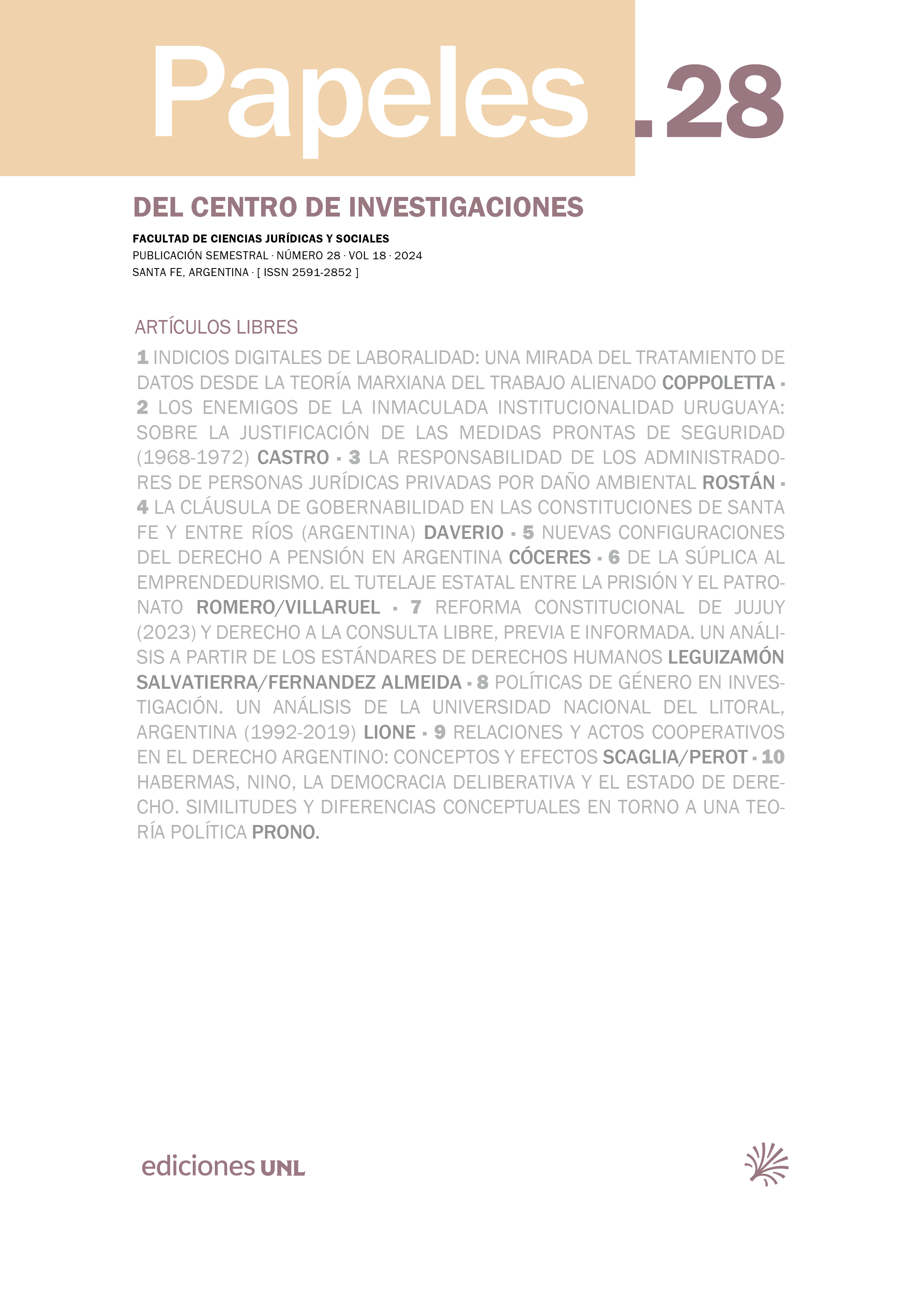
The governavility clause in the constitutions of Santa Fe and Entre Ríos (Argentina)
DOI:
https://doi.org/10.14409/pc.2024.28.e0036Keywords:
Legislative power, Representation, Governance, Electoral system, MinoritiesAbstract
The application of the governability clause in the distribution of seats in provincial legislatures generates distortion in political representation. Overrepresentation in favor of the political party that wins the election and underrepresentation that harms the remaining forces. Artificial majorities are thus generated that find their justification in the need to strengthen the Executive Branches so that they have the capacity to promote their government plans. However, in recent years a series of opinions have been gaining strength that insist that governability depends not only on the majority of seats in the legislative chambers but, in addition, it is necessary to observe other conditions such as the levels of internal homogeneity of the majority coalitions, the leadership capacity of their representatives, the greater or lesser ability and/or skill to negotiate and build agreements, among other reasons. That is why we understand that it would be pertinent for this clause to be reviewed, diagramming a representation mechanism that emphasizes a new role for both the Legislative Branch and the Executive Branch in the face of a procedure for the formation and sanction of laws that contemplates different tools. to resolve eventual situations of bid or tie with respect to a legislative majority opposed to the Governor.
References
BOBBIO, N., MATTEUCCI, N. y PASQUINO, G. (1994). Diccionario de Política. 8va. Ed. en español, revisada y ampliada. Ciudad de México: Siglo XXI editores.
CAMOU, A. (2001). Los desafíos de la gobernabilidad. Estudio preliminar y compilación. 1° Ed.. Ciudad de México: Flacso, IISUNAM, Plaza y Valdez SA. Disponible en: https://issuu.com/jooselitoparker/docs/los_desaf__os_de_la_gobernabilidad
D’AGOSTINO, J. (2018). Constitución de Entre Ríos: comentada, concordada, antecedentes, jurisprudencia. 1º Edición. Paraná: Delta Editores.
DUVERGER, M. (1965). Los Partidos políticos: su organización y actividad en los estados modernos. 3ra. Edición. Ciudad de México: Fondo de Cultura Económica.
FORO DE INNOVACIÓN POLÍTICA (2018). Fortalecer la Representación y la Participación para una ciudad más Democrática, Inclusiva y Sostenible. Conclusiones. Córdoba. Disponible en: https://www.nuestracordoba.org.ar/sites/default/files/S%C3%ADntesis%20de%20los%20paneles%20del%20Foro%20Innovaci%C3%B3n%20Pol%C3%ADtica%202018.pdf
GIULIANO, D. (2010). Derecho Constitucional Provincial: Poder Legislativo. Derecho Procesal Parlamentario. 1º Edición. Buenos Aires: Ediar.
LIJPHART, A. (1995). Sistemas electorales y sistemas de partidos: un estudio de veintisiete democracias, 1945–1990. Traducción de Fernando Jiménez Sánchez, Colección Estudios Políticos. Madrid: Editorial Centro de Estudios Constitucionales.
MEDINA, J. (1945). La Constitución de Entre Ríos. Comentarios. Tomo I. Rosario: Librería y Editorial Ciencia.
NOHLEN, D. (1995). Sistemas electorales y partidos políticos. Colección Política y Derecho. Ciudad de México: Fondo de Cultura Económica. Disponible en: http://ru.juridicas.unam.mx/xmlui/handle/123456789/10874
NOHLEN, D. (1999). Sistemas de Gobierno, Sistema Electoral y Sistema de Partidos: opciones institucionales a la luz del enfoque histórico-empírico. Ciudad de México: Tribunal Electoral del Poder Judicial de la Federación, Instituto Federal Electoral – IFE y Fundación Friedrich Naumann. Disponible en: https://www.te.gob.mx/sites/default/files/publicaciones/file/sistgob.pdf
RAE, D. (1977). Leyes electorales y sistemas de partidos políticos. Estudios Comparados. Madrid: Centro de Investigación y Técnicas Políticas (CITEP).
SARTORI, G. (2003). Ingeniería constitucional comparada. Una investigación de estructuras, incentivos y resultados. Con el posfacio: La transición de México, ¿hasta dónde? Una agenda para la reforma. Trad. de Roberto Reyes Mazzoni. 3ra. Edición. Colección Política y Derecho. Ciudad de México: Fondo de Cultura Económica.
ULLA, D. (2000). “El Poder Legislativo de la provincia”. Zeus, Colección Jurisprudencial, T. 84 (set.-dic.), 147-160, Buenos Aires.
URDANOZ GANUZA, J. (2006). “Medición de la desproporcionalidad electoral: una crítica a los Mínimos Cuadrados”. Revista Española de Investigaciones Sociológicas (REIS), N° 115, 257-295, Madrid. Disponible en: https://academica-e.unavarra.es/bitstream/handle/2454/26622/REIS_2006_115_Urd%C3%A1nozMedici%C3%B3n.pdf
ZARATE PEREZ, J. y JUAREZ CRUZ, A. (1999). “La cláusula de gobernabilidad en el Derecho Electoral mexicano”. Boletín del Centro de Capacitación Judicial Electoral, Tribunal Electoral del Poder Judicial de la Federación, Año 5, N° 1, Enero-Febrero, Ciudad de México. Disponible en: https://www.te.gob.mx/sites/default/files/publicaciones/doc-relacionado/bol_a5_1.pdf
Downloads
Published
Issue
Section
License
Copyright (c) 2024 Gustavo Javier Daverio

This work is licensed under a Creative Commons Attribution-NonCommercial-ShareAlike 4.0 International License.