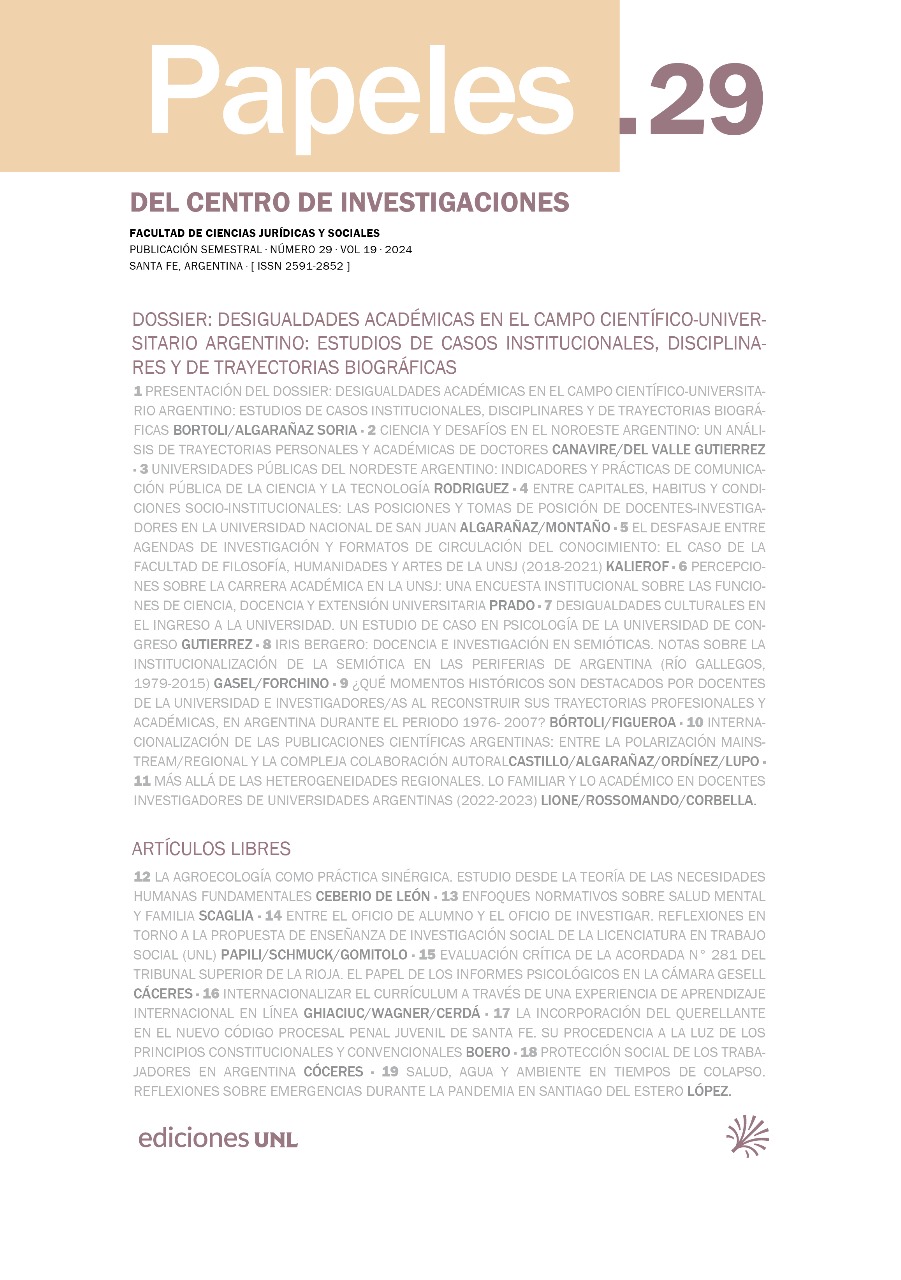
Cultural inequalities in college admissions. A case study in the psychology program at the Congreso University
DOI:
https://doi.org/10.14409/pc.2024.29.e0049Keywords:
Educational inequality, Cultural capital gap, Pedagogical inclusion, University adaptationAbstract
The article examines the inequalities of cultural capital among first-year Psychology students at the Congreso University, in San Juan. The research is based on a situated practice and is part of the final integrative work of the University-level Teaching Specialization Program at the National University of San Juan (UNSJ). The study reveals that the cultural capital inequalities that students bring to university have a significant impact on the learning process from the outset and create difficulties in students’ understanding of theoretical content and in the actual implementation of the academic program.
The research also highlights the need to adapt pedagogical practices and curricular content to address the cultural diversity of the student body. Consideration of the heterogeneity of students' cultural capital is crucial for reformulating teaching methodologies on the basis of their individual trajectories and for promoting the effective integration of first-year Psychology students into the academic environment, thus reducing inequality gaps. This perspective underpins a proposal for pedagogical intervention which is currently being reviewed and analyzed by the Management Team and the Student Guidance Service (SOE) of the same University
References
Anijovich R y Mora S. (2010). Estrategias de enseñanza. Otra mirada al quehacer en el aula. Buenos Aires. Aique Grupo editor.
Bourdieu, P. (1987) Los tres estados del capital cultural. En Sociológica, Nº:5, pp. 11-17. https://sociologiac.net/biblio/Bourdieu-LosTresEstadosdelCapitalCultural.pdf
Bourdieu P. y Passeron C. (2003) “Los herederos, los estudiantes y la cultura”. Siglo XXI Editores Argentina S. A.
Colorado, A. (2009). El capital cultural y otros tipos de capital en la definición de las trayectorias escolares universitarias. X Congreso Nacional de Investigación Educativa https://www.comie.org.mx/congreso/memoriaelectronica/v10/pdf/area_tematica_16/ponencias/1732-F.pdf
Edelstein, G (2011) Formar y formarse en la enseñanza. Ed. Paidós. Bs. As.
Ezcurra, A. M. (2007). Los estudiantes de nuevo ingreso: democratización y responsabilidad de las instituciones universitarias. Pró-Reitoria de Graduação da USP.
Gentili, P. (2009). Marchas y contramarchas. El derecho a la educación y las dinámicas de exclusión incluyente en américa latina (a sesenta años de la declaración universal De los derechos humanos). Revista Iberoamericana de Educación. N.º 49 (2009), pp. 19-57
Perrenoud, Philippe (2004). Diez nuevas competencias para enseñar. Invitación al viaje. Editorial Barcelona.
Rama Viale, C. (2006) La tercera reforma de la educación superior en América Latina y el Caribe: masificación, regulación e internacionalización. En; Informe sobre la Educación Superior en América Latina y El Caribe 2000-2005. La metamorfosis de la educación superior. Venezuela; IESAL. UNESCO
Sánchez-Cardona, I., & Rodríguez-Arocho, W. C. (2011). Valoración crítica a la teoría de aprendizaje situado y del concepto de comunidades de práctica desde el enfoque histórico-cultural. Revista De Educación De Puerto Rico (REduca), 44(1), 113–132. https://revistas.upr.edu/index.php/educacion/article/view/16563
Scandurra, R. (2009). La persistente influencia del origen social sobre la desigualdad de resultados. Una aproximación multi-nivel a partir de PISA 2009. https://dialnet.unirioja.es/servlet/articulo?codigo=5144554
Vasilachis de Gialdino, Irene Coordinador (2006). Estrategias de investigación cualitativa. Barcelona: Editorial Gedisa Mexicana S.A. .
Yuni, José y Urbano, Claudio (2006). Técnicas para investigar. Recursos metodológicos para la presentación de proyectos de investigación. vol. 2. Córdoba: Brujas.
Downloads
Published
Issue
Section
License
Copyright (c) 2024 Leticia Gutiérrez

This work is licensed under a Creative Commons Attribution-NonCommercial-ShareAlike 4.0 International License.